

An Overview of Surface Treatment for Three-Dimensional Objects

If you’ve attempted to print, label, or otherwise decorate a three-dimensional (3-D) product, you’ve probably been frustrated by an ink or adhesive that refused to adhere to the part’s surface. You may have tried different types of ink or adhesive formulations to get the job done, perhaps even used chemical primers or batch-treating processes. Still,…
Read MoreSurface Activation Systems For Optimizing Adhesion To Polymers

Abstract Many experiments have been performed globally to investigate ways of improving adhesion to polymers. This paper discusses current atmospheric surface activation systems, appropriate measurements of wettability and adhesion, over-treatment effects and surface analysis techniques relative to optimizing the adhesion of inks, paints, coatings and adhesives to polymer surfaces. Recommendations for improved activation by substrate…
Read MoreImproving UV Coating Results with Corona & Plasma Surface Preparation

UV coatings are a great choice for high value applications where scratch resistance and surface performance are essential. While traditional UV lamps are still used, the advancement of LED curing technology has improved operational efficiencies for numerous applications. This article reviews the importance of properly preparing surfaces for bonding with a variety of in-line surface…
Read MoreBonding Styrenic Copolymers to Replace PVC

The desire to find a cost-effective, yet environmentally friendly alternative to PVC is the focus of a new technical paper: Bonding Styrenic Copolymers and Thermoplastic Elastomers in the Quest to Replace PVC. The paper details current research on the benefits of using light-curable adhesives and surface treatment technology to optimize bond strength of competitive high…
Read MoreCustom Integrated Conveyor Systems for Flame Treating Applications

Enercon flame treating systems can be integrated in a variety of configurations based on each application’s requirements. In many cases, the flame is integrated with a robot so the flame burner can follow a precise path over the parts to be treated. In other cases, the flame burner is in a fixed position and parts are presented…
Read MorePlasma & Flame Treatment Prepares Aluminum Surfaces for Bonding
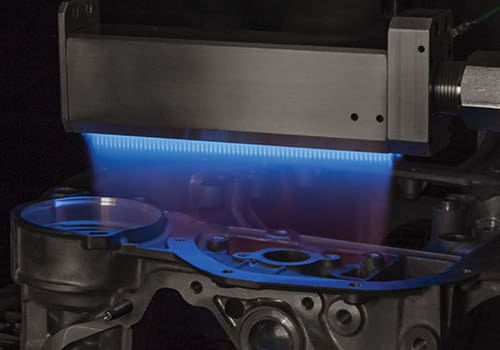
Bonding to aluminum can be major challenge. Engineers typically rely on adhesives to bond aluminum without welding. Depending upon application requirements, there are several adhesives and VHB foam tapes that have proven effective. However, all adhesive-based remedies are subject to failure if surface preparation is overlooked. Aluminum Surface Contaminates Aluminum is often annealed to achieve…
Read MoreAutomation Improves Plasma & Flame Surface Treatment Productivity
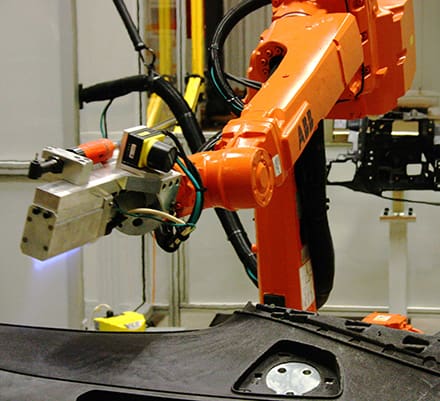
The manufacturing of virtually everything from toothbrushes to auto parts can benefit from the use of atmospheric plasma treatment and flame treatment during assembly and decorating operations. These technologies increase material surface energy to promote bonding with inks, adhesives, paints and other coatings. Companies in the medical, automotive, packaging, consumer products, wire & cable, sporting goods, furniture, and others markets find that…
Read MoreImprove Label Adhesion on Bottles – Flame & Plasma Treaters

When packagers are faced with label adhesion challenges, flame and plasma surface treaters are often used to increase bond strength. Label adhesion problems on bottles occur because many of the container, lid and cap materials used in packaging are chemically inert and non receptive to bonding with glue. Options for improving labeling success include changing…
Read MoreContinuous Inkjet Printing for Industrial Manufacturing Applications

As a non-contact printing process, inkjet offers manufacturers tremendous production advantages including variable data, fast changeover and reliability at top line speeds. Applications abound for plastics and rubber in the wire & cable, packaging, coding & industrial manufacturing industries. However material properties, surface contamination, ink/material compatibility and durability requirements create challenges. Keys for successful ink…
Read MoreWhat Plasma Actually Does to a Surface to Improve Adhesion

How Plasma Power Density & Custom Treater Designs Impact Success Air plasma surface treating is an emerging green technology for leading manufacturers tasked with assembling and decorating plastics, composites, glass and metals. You can see the effects of plasma treatment with improved adhesion of inks, adhesives, coatings and paints. You can use dyne solutions to…
Read More