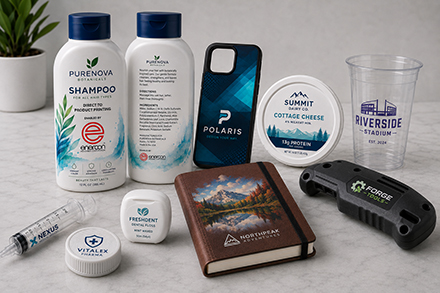

Optimize Direct-to-Product Printing for Consumer Goods
Download a copy of the webinar slides here.
Direct-to-product digital printing is rapidly emerging as decorators seek to produce an upscale, no-label look for their products. It offers significant production advantages, including faster changeovers, serialization capabilities, reduced inventory requirements, elimination of pre-printed label costs, and less material waste.
Because every surface is unique, how do you know which printing platform and ink to use and if the operation will benefit from surface preparation?
The good news is that printing experts from Engineered Printing Solutions and surface treating experts from Enercon have the experience and insights to help guide you through these challenges to optimize your decorating operations.
In this new webinar, you’ll learn:
- When surface pretreatment is needed
- Which technology is best for your application: corona, plasma, or flame?
- How to decide which digital printing platform to use
- What inks work best on specific materials
ABOUT THE PRESENTING COMPANIES
EPS builds industrial inkjet & automated pad printing lines and is the leader in industrial inkjet integration. Enercon Industries is the global leader in plasma, flame, and corona surface treating technologies.
Tips & Trends for Direct-to-Product Digital Printing for Consumer Goods
Key Takeaways from the Webinar Transcript
Direct-to-product digital printing is transforming the consumer goods industry by enabling greater flexibility, faster changeovers, improved sustainability, and highly customized product decoration. As brands introduce more SKUs, regional variations, and personalized packaging, digital printing technologies are becoming an increasingly attractive alternative to traditional print methods.
In this webinar, experts from Enercon Industries and Engineered Printing Solutions discuss the factors driving digital print adoption, the importance of surface treatment, and how manufacturers can improve print quality, adhesion, and production consistency.
Why Direct-to-Product Digital Printing Is Growing
Several market forces are accelerating the adoption of direct-to-product digital printing:
Product and SKU Proliferation
Brands continue to expand product offerings through:
- New flavors and package sizes
- Regional language variations
- Club-store and retail-exclusive packaging
- Online-exclusive products
- Subscription-based offerings
- Boutique and emerging brands
This growing complexity makes short-run production and rapid changeovers increasingly important.
Sustainability Initiatives
Direct printing often eliminates the need for labels and other secondary packaging components. By printing directly onto containers, lids, and closures, manufacturers can:
- Reduce packaging materials
- Eliminate mixed-material constructions
- Simplify recycling streams
- Support corporate sustainability goals
Advancements in Digital Print Technology
Improvements in printheads, electronics, and software now enable:
- Higher production speeds
- Improved image quality
- Reliable variable-data printing
- Greater production flexibility
At the same time, many experienced conventional print operators are retiring, creating additional incentives to adopt automated digital technologies.
The Importance of Surface Preparation
While digital printing delivers significant advantages, consistent print quality depends on one critical factor: surface quality.
For reliable adhesion and image consistency, manufacturers need a uniform, predictable printing surface. This is where surface treatment technologies such as plasma and flame treatment play a vital role.
Understanding Surface Energy, Wettability, and Adhesion
Successful printing depends on the relationship between the substrate and the ink.
Cohesion vs. Adhesion
- Cohesive forces hold an ink droplet together.
- Adhesive forces attract the ink to the surface being printed.
When surface energy is low, the ink remains tightly beaded, creating poor wetting and limited adhesion. Increasing surface energy allows the ink to spread more evenly, improving print quality and durability.
Surface Energy and Contact Angle
Untreated plastics often have low surface energy and high contact angles, making them difficult to print. Surface treatment increases surface energy while reducing contact angle, resulting in:
- Better ink wetting
- Improved image quality
- Stronger adhesion
- Greater process consistency
Common Challenges That Affect Adhesion
Several factors can prevent inks from bonding properly:
- Naturally low-energy plastic surfaces
- Mold-release agents
- Surface contamination
- Flame-retardant additives
- Environmental exposure
- Mechanical stress
- UV degradation
These factors reduce available bonding sites and make surfaces more difficult to print.
Traditional Surface Preparation Methods & Surface Treatment Technologies
Several traditional methods are available to improve surface adhesion.
Liquid Primers: Liquid primers and solvent-based treatments can improve adhesion but often introduce variability due to manual application methods.
Mechanical Surface Preparation: Methods such as sanding, blasting, and laser ablation can increase surface roughness. However, they typically do not increase surface energy and often require additional cleanup and processing.
Vacuum Plasma: Vacuum plasma systems can be effective but are generally batch processes requiring longer cycle times and higher capital investment.
Atmospheric Plasma and Flame Treatment: Atmospheric plasma and flame treatment offer several advantages.
- Inline processing
- High production speeds
- Lower operating costs
- Consistent and predictable results
- Easy integration into production lines
These technologies are widely used for direct-to-product digital printing applications.
How Plasma Treatment Works
Plasma is often referred to as the fourth state of matter. By adding energy to a gas, plasma is created containing:
- Free radicals
- Positive and negative ions
- Free electrons
- Ultraviolet energy
When applied to a substrate, plasma performs three important functions.
- Cleaning: Plasma removes organic and inorganic contaminants that can interfere with ink adhesion.
- Etching: The process microscopically textures the surface, increasing usable surface area and creating more opportunities for mechanical bonding.
- Functionalization: Plasma introduces polar chemical groups that increase surface energy and improve wettability.
Together, these effects significantly enhance adhesion and print performance.
Single-Pass vs. Multi-Pass Digital Printing
Multi-Pass Inkjet
Multi-pass systems are often used for:
- Promotional products
- Low-volume production
- Short-run customization
Advantages include lower equipment investment and greater flexibility for small production runs.
Single-Pass Inkjet
Single-pass systems are designed for high-volume manufacturing and offer:
- Production speeds up to thousands of parts per minute
- Inline automation
- Rapid changeovers
- Consistent production quality
Because products move continuously past fixed printheads, reliable surface treatment becomes essential.
Selecting the Right Printing Technology
Successful implementation depends on three primary considerations:
1. Material
Evaluate:
- Substrate type
- Surface energy
- Geometry
- Texture
- Coatings
- Recycled content
2. Application Requirements
Consider:
- Production speed
- Number of colors
- Variable data requirements
- Product changeover frequency
3. Manufacturing Environment
Assess:
- Available floor space
- Line integration requirements
- Operator skill levels
- Environmental regulations
- Use of solvents or flame systems
Real-World Application Examples
Dental Floss Containers. Single-pass digital printing combined with inline plasma treatment enables direct printing onto dental floss containers at production speeds approaching 2,000 parts per minute.
Polypropylene Lids. Digital printing has successfully replaced dry offset printing for many lid applications, reducing changeover time while maintaining production speeds of approximately 400 parts per minute.
Caps and Closures. Flame-treated caps and closures can be digitally decorated at rates ranging from 700 to 2,000 parts per minute, depending on size and system configuration.
PET Bottles. For thin-wall PET containers, plasma treatment is often preferred over flame treatment because it improves adhesion without introducing excessive heat that could distort the package.
Choosing the Right Ink
Ink selection depends on multiple factors, including:
- Substrate material
- Surface treatment method
- Regulatory requirements
- Food packaging considerations
- Recycling compatibility
- Cure technology
- Weatherability requirements
- Post-print processing needs
Successful applications rely on optimizing both the ink chemistry and the surface treatment process.
Key Takeaways
- Direct-to-product digital printing continues to gain momentum due to flexibility, sustainability, and production efficiency.
- Surface treatment is essential for achieving consistent print quality and adhesion.
- Plasma and flame treatment technologies improve wettability, surface energy, and bonding performance.
- Single-pass digital printing enables high-speed production but requires tightly controlled pretreatment processes.
- Ink, substrate, and surface treatment must be evaluated as a complete system.
- Reliable adhesion is engineered through proper material selection, pretreatment, and ink chemistry.
By combining the right surface treatment technology with the appropriate ink and printing platform, manufacturers can achieve durable, high-quality direct-to-product printing at production scale.