Custom Flame Surface Treating Burner Configurations for Challenging Applications
Once Enercon helps a manufacturer determine that flame surface treatment will effectively improve surface adhesion properties for their application, the real work begins. How can the flame treater be integrated into the manufacturer’s operation to ensure optimal productivity?
Flame treatment is a versatile surface modification technology recognized for its ability to treat complex geometries at high speeds. In many cases, a standard burner mounted over a conveyor is all that’s needed. When multiple burners are needed, Enercon will develop a custom configuration to ensure precise control over the entire treatment process.
However, not all burner designs are created equal and Enercon engineers are able to customize burners for the most challenging applications.
High-Velocity Burners for Fast, Consistent Treatment
Enercon’s high-velocity flame burners have long been a proven solution for robotic and inline applications. Designed to deliver a consistent and concentrated flame pattern, these burners provide uniform treatment on parts moving at production speeds exceeding 100 feet per minute.
Typical applications include:
- Automotive components prior to gasket or adhesive application
- Bottles and containers before printing or labeling
- Wood, flooring, and building products before coating
- High-speed web and profile treatment
The ability to process large surface areas rapidly often makes flame treatment a more economical alternative for applications where production throughput is critical.
New L-Style Burner Simplifies Multi-Sided Treatment
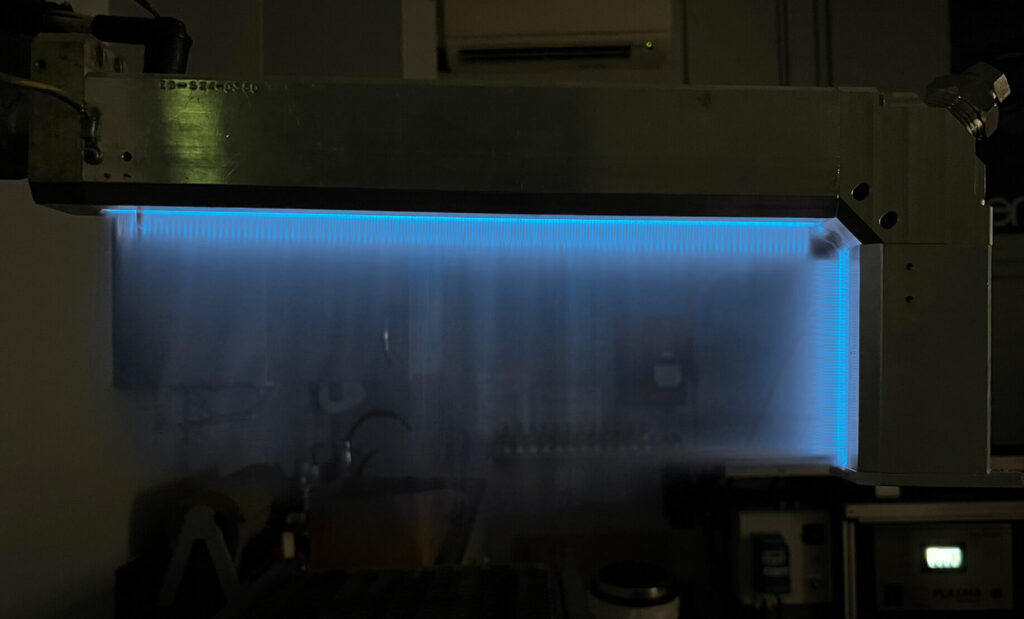
The L-style flame burner is designed specifically for applications that require simultaneous treatment of multiple surfaces.
Traditionally, treating two adjoining surfaces required multiple treatment heads and gas trains. In many cases, both burner sections needed to be the same length, resulting in unnecessary energy consumption when one side of the part required significantly less treatment area than the other.
The new L-style design solves this problem by allowing different burner lengths within the same assembly. Manufacturers can now efficiently treat two surfaces at once without oversized burners or costly custom systems.
Applications well-suited for the L-style burner include:
- Moldings and trim components
- Extruded profiles
- Building products
- Containers with complex geometries
- Components requiring treatment on adjacent surfaces
An additional benefit discovered during testing is the burner’s ability to provide uniform treatment through corner transitions, reducing concerns about over-treatment in critical areas.
V-Style Burners Enable Efficient 360-Degree Coverage
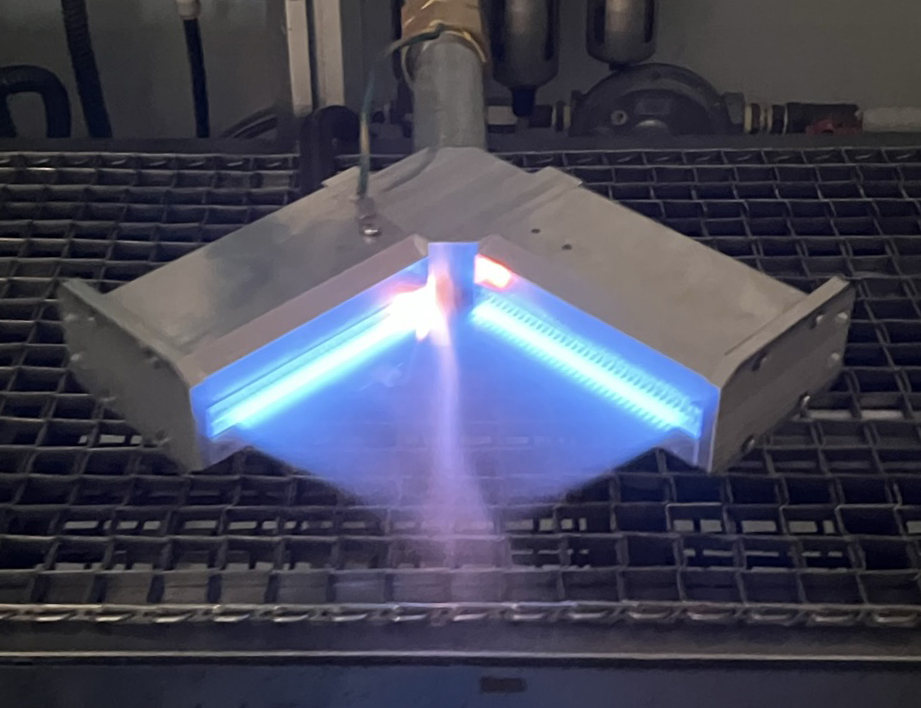
Building on the success of the L-style design, Enercon has also introduced a V-style burner configuration for products requiring circumferential treatment.
The V-style geometry allows manufacturers to efficiently treat tubing, profiles, and cylindrical components from multiple angles simultaneously. By surrounding more of the part with the treatment flame, manufacturers can achieve highly uniform surface activation while maintaining exceptional production speeds.
In applications such as tubing treatment, line speeds can exceed 100 to 200 feet per minute while still delivering consistent adhesion performance around the entire circumference of the product.
For manufacturers seeking 360-degree treatment without resorting to more complex custom burner arrangements, the V-style design provides a practical and cost-effective alternative.
Specialty Burner Designs Solve Unique Challenges
Not every application requires broad-area treatment. Some manufacturing processes demand precise treatment of small, localized regions.
For these applications, Enercon offers specialty burner configurations including pencil burners for targeted treatment areas. These compact burners allow manufacturers to treat only the necessary portion of a component while minimizing heat exposure to surrounding areas.
Applications include:
- Window and frame assemblies
- Adhesive bonding paths
Selecting the Right Surface Treatment Technology
While atmospheric plasma and flame treatment are both highly effective methods for increasing surface energy, the optimal solution depends on the application requirements.
For intricate, localized treatment zones, atmospheric plasma often provides excellent precision. For larger parts, multi-sided geometries, and high-speed production environments, flame treatment may offer significant advantages in throughput and economics.
As products become more complex and production demands increase, having the right burner design can make all the difference in delivering reliable adhesion and consistent manufacturing results.